
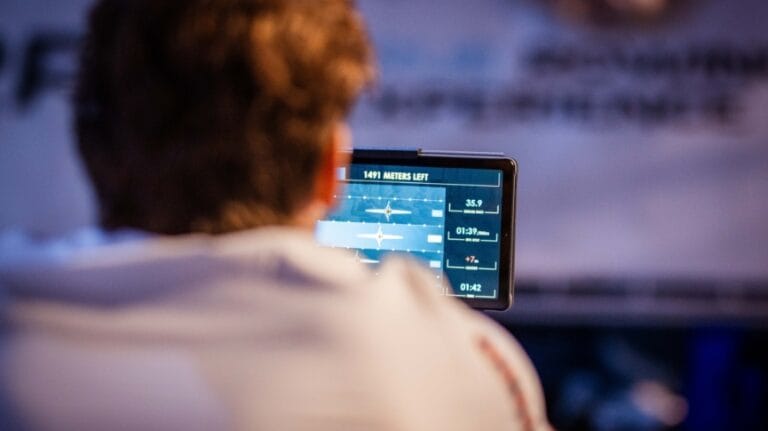
Alongside RP3, MoveLab are involved with every immersive indoor rowing experience you’ve previously ever had. Founded in 2021, the company provides connectivity software across multiple sports, but traces its roots back to rowing. Set up by Joris Blaak and Niek Haarman Duteweerd, the company underpins the technology offering that continues to differentiate RP3 as a provider of on and off-water experiences.
Speaking with Joris just a couple of days before the NKIR (Nederlands Kampioenschap Indoorroeien), which is entirely RP3 adopted, Joris explained that the company came to be after their consultancy work grew in size. “With a group of partners, including RP3, we thought to ourselves: what if we found a company that only does fitness-related software?” remembered Joris. This allowed Joris and the team to focus on building great experiences and a best-in-class team to power the performance of the software.
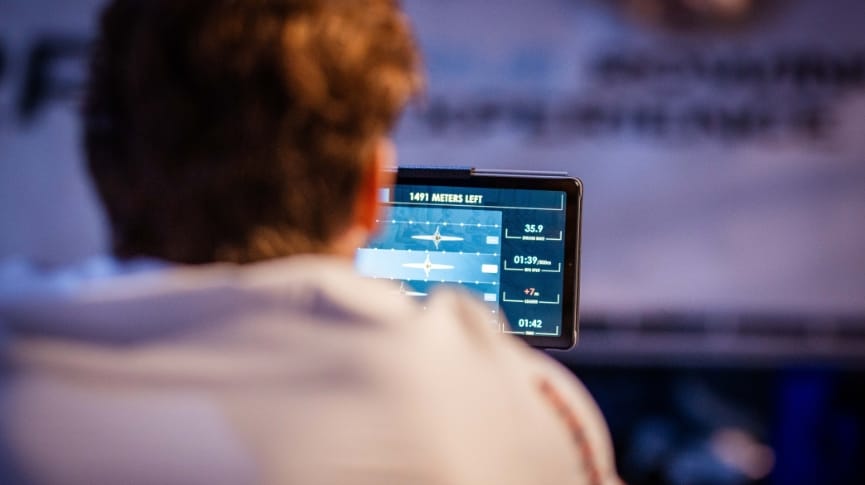
In short, MoveLab defines the term as ‘connected fitness’. The software focuses on the planning and execution of a workout, ranging from monitors on the equipment displaying real-time metrics to the architecture required to record, store, and analyse workouts, provide training plans, and stream videos. “We do this for rowing machines, treadmills, weight stacks, but even just floor exercises,” explained Joris. “It allows our users to play back videos and track performance. We can even provide software to gym franchises if they want to offer a unique fitness experience for their customer base.”
At RP3, we are dedicated to providing not only the ultimate off-water simulation but also the best quality of data and tools available to analyse and understand that data. Only by engaging in this process can athletes, coaches and programmes improve their collective output in an age where data-driven hypotheses are becoming essential across all of sport. “The partnership we have with RP3 allows us to continue to grow outside of their business, take on new clients, gain additional knowledge, and then apply that knowledge to RP3,” said Joris. “Accelerating their innovative offerings would not be possible if it were only their in-house team working on it. Collaborating with us is the best of both worlds.”
MoveLab’s unique proposition is working with the manufacturers to plug sensors onto machines, figure out the best way to interpret the data that is generated and the value that has for the user. “One of the key features of the RP3 is the force curve. During your rowing stroke, you can see the force curve being drawn in real time in high resolution. That is where we start,” said Joris. “With the combined knowledge of RP3 and MoveLab, we can start to generate drive and recovery times, peak force positions, all produced by technicality that we have developed together. It is almost certainly the best offering in the market.”
MoveLab will always be inherently linked to rowing, but the company is also moving in a couple of other directions. “We want to be more involved with commercial fitness, helping the broader gym ecosystem with software and allowing smaller start-ups to thrive with our technology,” said Joris. “In the rowing world, we want to be the connecting element within the indoor rowing software ecosystem. We work with companies like EXR to provide them with a connections library via our dialogue with manufacturers. That goal translates to accelerating innovation within rowing, removing the barriers for all of these machines and manufacturers to integrate.”
Rowing is not a big market, and software is notoriously difficult to get right. In just four years, though, MoveLab has made significant strides in modernising the indoor rowing experience. In another four years, alongside the support of RP3, it feels likely that the landscape will have evolved substantially again.


We will send you a personal quote as soon as possible.
As soon as the quote is ready, you will receive a link by email to order directly.